


Lesson 10 of 16
W and N
わ is wa, を is almost always the particle "o" (written wo), and ん is the lone consonant n. You'll meet を constantly in sentences but rarely inside words.
Pronunciation
How it sounds
わ is wa with lips only lightly rounded. を sounds exactly like お in everyday speech. ん is a full beat of its own, a hummed n; before m, b, and p sounds your lips close, so it sounds like m.
Reading tips
Easy to mix up
を is used almost only as the particle that marks the object of a verb: ほんをよむ (hon o yomu) means “read a book”.
ん never starts a word, so you will only see it in the middle or at the end.
わ and れ are easy to swap: わ ends in a round curve, れ in an open flick.
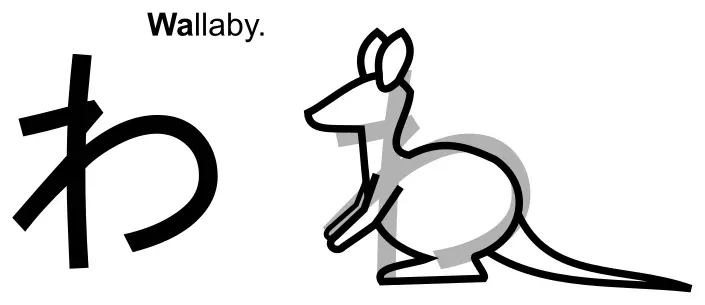
A Wallaby, standing on its tail.
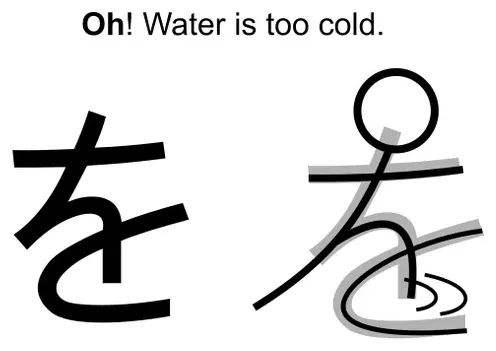
Oh! The water is too cold! A person dips a toe in. In sentences it is read "o".
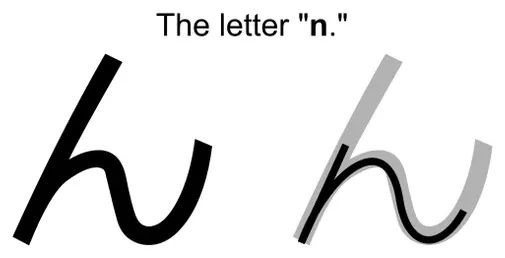
The letter "n". The kana looks like a cursive n.
Real vocabulary
Words you can read now
ほん
hon
book
にほん
nihon
Japan
みかん
mikan
mandarin orange
わたし
watashi
I, me
わかる
wakaru
to understand
せんせい
sensei
teacher